


In Brief: Do You Need to Be Good at Math for Bookkeeping?
- You do not need advanced mathematics to begin learning bookkeeping.
- Basic arithmetic, percentages, and attention to detail are useful starting skills.
- Accounting software performs calculations but cannot guarantee that the information entered is correct.
- Reviewing everyday calculations can help build confidence before training.
____________________________________________________________________________
Do you need to be good at math for bookkeeping? No, you don’t need to be a math expert. Bookkeeping mainly involves everyday numerical skills, such as addition, subtraction, multiplication, division, and percentages.
If math was never your favourite subject, that doesn’t automatically mean bookkeeping is out of reach. What matters is your willingness to practise, check your work, and understand what the numbers represent.
For people considering bookkeeping training, building confidence with these basic skills is a useful place to start.
Do You Need to Be Good at Math for Bookkeeping?
What kind of math does bookkeeping involve? Most routine calculations use basic arithmetic and percentages rather than advanced algebra or calculus.
Here are some examples of how bookkeeping math skills appear in everyday tasks.
| Bookkeeping Task | Numerical Skill | Example |
| Checking an invoice | Addition | Confirm that $80 + $45 + $25 = $150 |
| Calculating a discount | Percentages | Find 10% of $200 = $20 |
| Checking a payment | Subtraction | $500 owed − $350 paid = $150 remaining |
| Finding a discrepancy | Comparing figures | Identify why a recorded $275 payment differs from a $257 receipt |
These calculations are straightforward individually, but accuracy matters. A small mistake can affect the information a business uses to track its finances.
Why Are Accuracy and Problem-Solving Important in Bookkeeping?
Being comfortable with numbers helps, but bookkeeping also requires patience and careful checking. Imagine entering a payment of $257 as $275. The difference is only $18, yet the records will no longer match the original receipt.
A careful bookkeeper notices the mismatch, checks the source document, and corrects the entry according to the appropriate procedure. This illustrates why accounting skills for beginners include more than arithmetic. Students also need to learn how to review information, identify errors, and understand where a calculation may have gone wrong.
So, is bookkeeping hard to learn? Not exactly. It helps to remember that these habits develop through repeated practice. You are not expected to approach every unfamiliar task with complete confidence on your first attempt.

What Can Accounting Software Do for You?
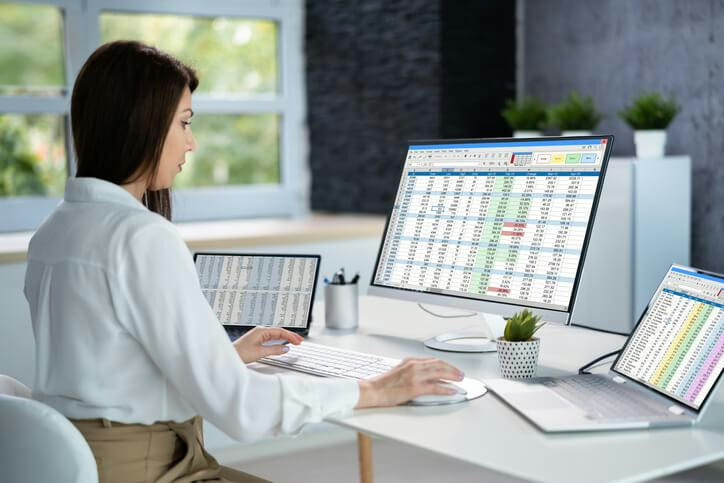
Accounting software can automatically add figures, calculate totals, organize transactions, and generate reports. Spreadsheet programs such as Excel can also help with calculations. However, software cannot guarantee that the information entered is accurate.
If someone records the wrong amount, selects an incorrect account, or enters a transaction twice, the software may still process the information. For example, a spreadsheet can correctly add three numbers even when one of those numbers was copied incorrectly from an invoice.
This is why students benefit from understanding basic calculations before relying entirely on digital tools. DCC’s Business Finance Management training includes manual bookkeeping, Excel, and accounting software, helping students connect financial concepts with the tools used to manage information.
How Can You Prepare if You Lack Confidence With Numbers?
You don’t need to master bookkeeping before starting a program. Instead, focus on a few manageable ways to strengthen your confidence.
- Review basic arithmetic: Practise adding, subtracting, multiplying, and dividing everyday amounts.
- Work with percentages: Try calculating a 10% discount or a 5% increase.
- Check your answers: Use a calculator to verify results and understand any differences.
- Practise with spreadsheets: Enter a few expenses and use simple formulas to calculate totals.
- Read numbers carefully: Compare receipts, invoices, and payment amounts to identify discrepancies.
These exercises are useful preparation for bookkeeping courses in BC, especially if you have been away from formal education for some time. You can begin with small examples and gradually move toward more detailed financial records.
What Should You Know Before Starting Bookkeeping Training at DCC?
The skills needed to begin training are not the same as the skills you will develop during the program. A reasonable starting point is familiarity with everyday calculations and a willingness to work carefully with numbers. Training can then introduce more structured bookkeeping methods, financial records, and software.
Students interested in broader administrative work can also explore our Business Office Administration program. Before enrolling, it is worth reviewing the program’s entry criteria rather than assuming that your previous math grades determine your eligibility.
Would you like to discuss admission requirements with DCC?
Contact us for more information.
Key Takeaways
- Bookkeeping relies mainly on arithmetic, percentages, and careful numerical checks.
- Accuracy and problem-solving matter as much as calculation speed.
- Software helps with calculations but does not replace human judgment.
- Students can improve their confidence by practising simple financial examples.
- Admission requirements should be checked directly rather than inferred from past math performance.
FAQ
What Math Skills Do You Need for Bookkeeping?
Basic addition, subtraction, multiplication, division, and percentages are useful. Bookkeepers also need to compare figures and identify errors.
Can You Study Bookkeeping if Math Was Not Your Strongest Subject?
Yes. Advanced mathematics is not usually required for routine bookkeeping tasks. However, students need to be willing to practise numerical skills and work accurately.
Do You Need Accounting Experience Before Starting Bookkeeping Training?
Previous accounting experience is not necessarily required for beginner-level study, but admission requirements vary by program. Check the specific requirements before applying.
Does Accounting Software Do All the Calculations for You?
Software can perform many calculations automatically, but users must still enter accurate information, select appropriate accounts, and review results.
How Can You Prepare for Bookkeeping Courses?
Review basic arithmetic and percentages, practise checking invoices, and become familiar with simple spreadsheet formulas. These activities can help you approach training with greater confidence.